About Chiller
About Chiller
A chiller is a device that circulates liquids, such as water, to cool or heat a target device (or part of a device) and control its temperature.
Chillers are primarily used for cooling, and their name comes from the English word “chill.”
By using a chiller, the temperature of the liquid can be precisely controlled, allowing it to maintain a constant temperature.
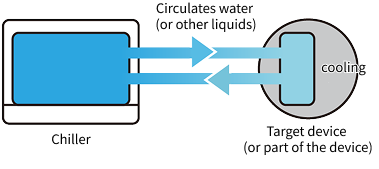
Chiller Overview
A chiller consists of a refrigerant circuit including a compressor and a condenser, and a chilled water circuit including a water tank and pump. By exchanging heat between the refrigerant and chilled water circuits through a heat exchanger, the chiller can supply water at a stable temperature to the target device.
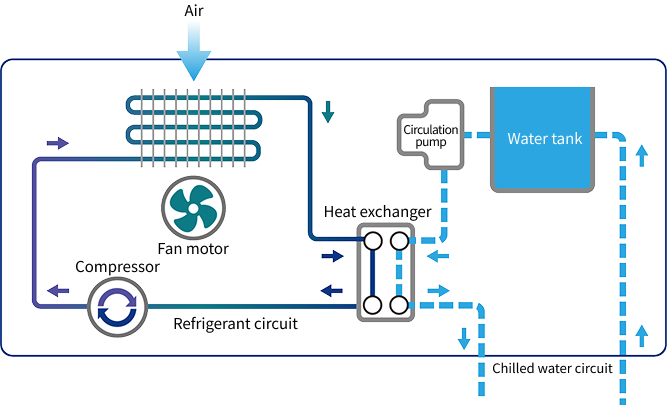
Refrigerant circuit
The chiller’s refrigerant circuit contains a sealed refrigerant gas. The compressor compresses the gas, raising its temperature and pressure. The gas is then cooled in the condenser, causing it to liquefy. Passing through the expansion valve lowers its pressure and temperature, and as it absorbs heat in the heat exchanger, it provides a cooling effect and vaporizes again. The refrigerant then returns to the compressor, and this cycle repeats.
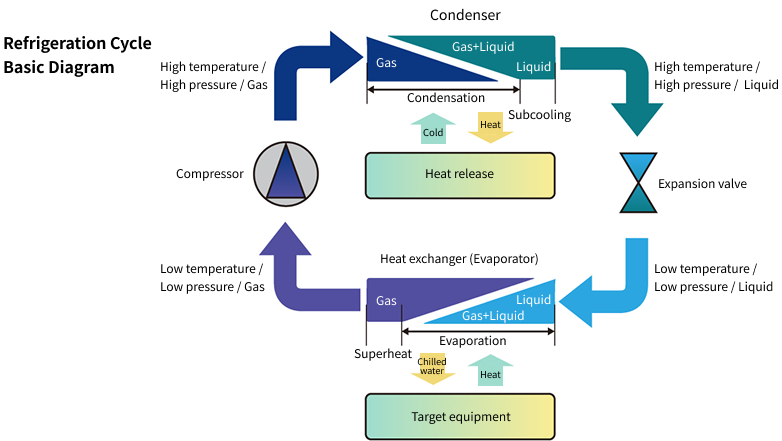
Types of Chillers
Chillers have two types of condenser cooling methods: air-cooled and water-cooled.
Air-Cooled Chillers
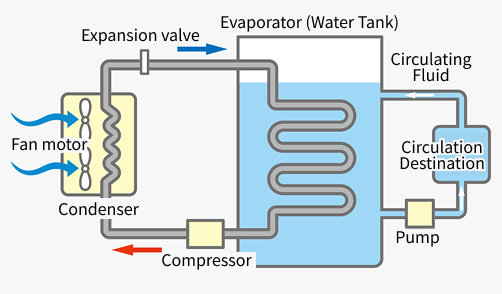
Features of Air-Cooled Chillers
Condenser is cooled using outside air via a fan
Enables construction of a simple chiller system
Noise control is necessary in urban areas
Chiller performance depends on ambient air temperature
Easy to install, but attention to installation environment is required
Water-Cooled Chillers
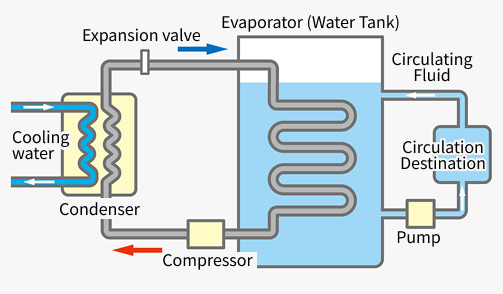
Features of Water-Cooled Chillers
Condenser is cooled using externally supplied cooling water
Requires cooling water facilities, resulting in higher cost than air-cooled types
Chiller performance is stable due to water circulation cooling
Measures against freezing of cooling water are necessary in cold regions
Maintenance of cooling water facilities and water quality management are required
How to Choose a Chiller
1
Determine the desired temperature of the circulating water
2
Decide on the installation location
・Outdoor installation (air-cooled)
Suitable when there is no indoor space or to avoid heat discharge indoors.
・Indoor installation (air-cooled or water-cooled)
Ideal if the chiller needs to be close to the target equipment. Cooling towers can use factory circulating water.
3
Choose the liquid to be cooled by the chiller
(Options include tap water, pure water, antifreeze solutions, brine, etc.)
4
Confirm the required cooling capacity

5
Check pump capacity
Details such as distance to the target equipment and piping specifications are required. Please contact us for a consultation.
Water-Cooled Chiller
Low-temperature (≤10 °C) Medium-temperature (10-30 °C) High-temperature (≥30 °C)Applications of Chillers
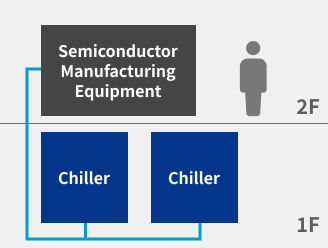
Example: Semiconductor Factory
Keeps equipment and process fluids at a constant temperature.
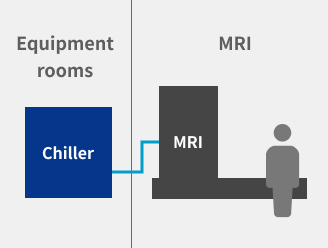
Example: Medical Field
Cools helium gas systems used in MRI equipment.
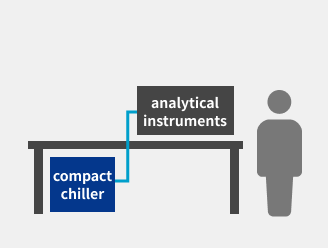
Example: Laboratory
Cools analytical instruments to maintain stable operation.