We are a company that handles refrigerant gases. To protect the environment, we comply with the Fluorocarbon Emission Control Law and properly manage refrigerant gas disposal. Our company is registered as a Type 1 fluorocarbon recovery contractor in each prefecture, and all our service personnel have obtained certification as refrigerant recovery technicians issued by the Refrigerant Recovery Promotion & Technical Center. From an environmental perspective, we actively develop energy-saving products such as DC inverter chillers. In addition, we make efforts to comply with RoHS regulations by avoiding the use of the ten restricted substance
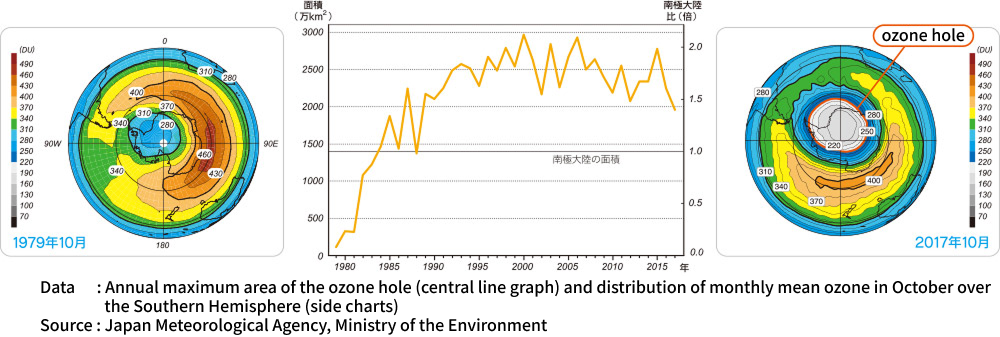
ultraviolet (UV) rays and protects living organisms on Earth. However, certain fluorocarbons, such as CFCs and HCFCs, released into the atmosphere can reach the ozone layer and cause its depletion. Over Antarctica, this has resulted in the so-called “ozone hole,” which has rapidly expanded since the 1980s. Although recent observations show no long-term expansion trend, and the ozone layer is expected to recover to its original state by the end of this century, the situation remains serious and ongoing countermeasures are necessary.
The Act on Rational Use and Proper Management of Fluorocarbons, commonly known as the Fluorocarbon Emission Control Law, was amended and came into effect on April 1, 2015. For more details, please refer to the Ministry of Economy, Trade and Industry (METI) Fluorocarbon Emission Control Law portal site. http://www.env.go.jp/earth/furon/
■ What Are Fluorocarbons?
Fluorocarbons are a general term for compounds of fluorine and carbon. Under the Fluorocarbon Emission Control Law, CFCs (chlorofluorocarbons), HCFCs (hydrochlorofluorocarbons), and HFCs (hydrofluorocarbons) are collectively referred to as fluorocarbons.
Fluorocarbons are chemically very stable, easy to handle, and have low toxicity to humans. Because of these properties, they have been widely used in various applications, including refrigerants for air conditioners and refrigerators, foam materials such as insulation, cleaning agents for semiconductors and precision parts, and aerosols.
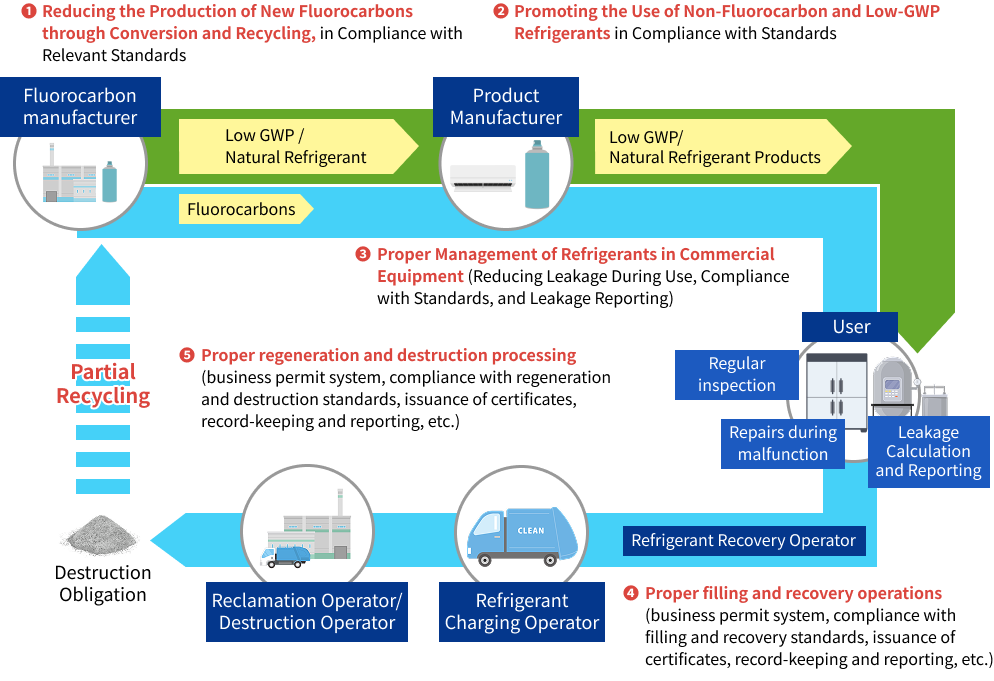
However, as their impact on the global environment—such as ozone layer depletion and global warming—has become evident, industries have been progressively shifting to fluorocarbons with lower environmental impact or alternative substances wherever possible.
■ Overview of the Fluorocarbon Emission Control Law
Our company is registered as a Type 1 Fluorocarbon Charging and Recovery Operator in all prefectures across Japan.
Owners of commercial air conditioning and refrigeration equipment are subject to the Fluorocarbon Emission Control Law as managers of Type 1 designated products or as operators responsible for disposal.
This includes equipment installed in a wide range of facilities such as offices, buildings, supermarkets, convenience stores, grocery stores, drugstores, manufacturing factories, research facilities, refrigerated warehouses, railways, ships, aircraft, food processing plants, fishing vessels, greenhouses, government offices, public halls, schools, and hospitals.
■ Manager
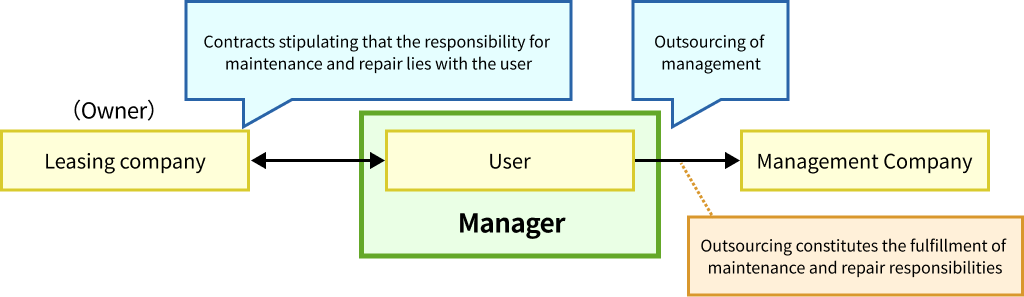
In principle, the owner of the equipment is considered the manager. However, as an exception, if a contract or other written document assigns the responsibility for maintenance or repair to a party other than the owner, that party becomes the manager.
Note: If maintenance, inspections, or other management tasks are outsourced, the party commissioning the work is regarded as the manager, as the commissioning constitutes the execution of maintenance and repair responsibilities.
・For all Specified Type I equipment (commercial refrigeration and air conditioning equipment), a simple inspection must be conducted at least once every three months.(There is no restriction on who may perform the inspection.)
・For Specified Type I equipment whose compressors use electric motors with a rated output of 7.5 kW or more, a regular inspection must be conducted at least once a year (for air-conditioning equipment under 50 kW, at least once every three years). (Inspections must be conducted by a person with sufficient technical knowledge.)
・Managers are required to properly manage equipment by recording inspection, repair, and refrigerant charge/recovery history for each unit. Note: If inspection and maintenance are outsourced to a certified refrigerant recovery contractor, the contractor may record the inspection and maintenance results in the inspection/maintenance log.
・The inspection/maintenance log must be kept at the business site until the equipment is disposed of, either in paper or electronic form.